CHESSBOOK REVIEWS

Latest book
reviews of 1 January 2026
Wilhelminalaan 33

7261 BP RUURLO

The Netherlands.
John
Elburg
Chess DVD's
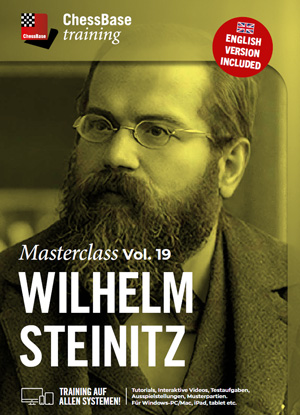
Master Class Vol. 19:
Wilhelm Steinitz
by Dorian Rogozenco, Dr. Karsten
Müller, Mihail Marin, Oliver Reeh
http://www.chessbase.com
E-Mail
info@chessbase.com
2026
Price Euro 34.90
Windows 7 or higher
Minimum: Dual Core, 2 GB RAM, DirectX11, graphics card with 256 MB RAM,
DVD-ROM drive, Windows Media Player 9, ChessBase 14/Fritz 16 or
included Reader and internet access for program activation.
Recommended: PC Intel i5 (Quadcore), 4 GB RAM, Windows 10, DirectX11,
graphics card with 512 MB RAM or more, 100% DirectX10-compatible sound
card, Windows Media Player 11, DVD-ROM drive and internet access for
program activation.
MacOSX only available as download! Minimum: MacOS "Yosemite"
10.10
William Steinitz (born Wilhelm Steinitz; May 14, 1836 – August 12,
1900) was a Bohemian-Austrian, and later American, chess player. From
1886 to 1894, he was the first World Chess Champion. He was also a
highly influential writer and chess theoretician.
So I am very pleased with this new master class DVD from ChessBase
under leadership from
Dorian Rogozenco, Dr. Karsten Müller, Mihail Marin and Oliver Reeh.
This all is well packed in eight hours video entertainment.
But first a view inside: Introduction
Short biography
Opening
Introduction
French Defence
Spanish
Scotch Game
Vienna Game
Strategy
Introduction
A Bridge between Steinitz and Modern Chess
Game 1: De Vere - Steinitz
Game 2: Bricard - Marin
Game 3: Zuckertort - Steinitz
Game 4: Steinitz - Chigorin
Game 5: Chigorin - Steinitz
Game 6: Steinitz - Zuckertort
Game 7: Steinitz - Lasker
Tactics 1
Pihal - Steinitz 1959
Hamppe - Steinitz 1860
Steinitz - Meitner 1860
Reiner - Steinitz 1860
Steinitz - Robey 1862
Steinitz - NN 1862
Novotny - Steinitz 1862
Steinitz - Andersen 1862
Steinitz - Thorold 1864
Green - Steinitz 1864
Steinitz - Duffy 1865
Steinitz - Burden 1865
Steinitz - MacDonnell 1866
Tactics 2
Steinitz - Stern 1870
Fisher - Steinitz 1872
Steinitz - Zuckertort 1872
Steinitz - Anderssen 1873
Steinitz - Gelbfuhs 1873 and more.
In 1894,Steinitz lost the title in a match against Emanuel Lasker.
William Steinitz, born in 1836 in the ghetto of Prague, then Austria,
came to Vienna in 1858, and soon became one of the best chess players
in the city. In 1862, he moved to the chess stronghold of London and
made a name for himself by defeating the other top players of the world.
All together we have one of the finest chess products of this moment!
Conclusion: A gift for every chess
player!
Calculation Step by
Step: A Grandmaster’s Training Guide Vol. 1 - Foundations
by Surya Ganguly
http://www.chessbase.com
E-Mail
info@chessbase.com
2026
Price Euro 34.90
Windows 7 or higher
Minimum: Dual Core, 2 GB RAM, DirectX11, graphics card with 256 MB RAM,
DVD-ROM drive, Windows Media Player 9, ChessBase 14/Fritz 16 or
included Reader and internet access for program activation.
Recommended: PC Intel i5 (Quadcore), 4 GB RAM, Windows 10, DirectX11,
graphics card with 512 MB RAM or more, 100% DirectX10-compatible sound
card, Windows Media Player 11, DVD-ROM drive and internet access for
program activation.
MacOSX only available as download! Minimum: MacOS "Yosemite"
10.10
Calculation Step by
Step: A Grandmaster’s Training Guide Vol 2 - Advanced Practice
by Surya Ganguly
http://www.chessbase.com
E-Mail
info@chessbase.com
2026
Price Euro 34.90
Windows 7 or higher
Minimum: Dual Core, 2 GB RAM, DirectX11, graphics card with 256 MB RAM,
DVD-ROM drive, Windows Media Player 9, ChessBase 14/Fritz 16 or
included Reader and internet access for program activation.
Recommended: PC Intel i5 (Quadcore), 4 GB RAM, Windows 10, DirectX11,
graphics card with 512 MB RAM or more, 100% DirectX10-compatible sound
card, Windows Media Player 11, DVD-ROM drive and internet access for
program activation.
MacOSX only available as download! Minimum: MacOS "Yosemite"
10.10
In this two-volume course, the great GM Ganguly learns the user to turn
calculation into a trainable skill where you won’t just only solve
tactics; but you you will learn to think ahead in chess!
In volume one I found:
Introduction
Forcing Moves
Example 1: Fernandez Garcia - Marino Bravo
Example 2: Panchanathan - Ganguly
Example 3: Babula - Anand
Example 4: Ganguly - Carmaciu
Example 5: Position 1
Example 6: Delchev - Polster
Short Calculation
Example 1: Position 1
Example 2: Position 2
Example 3: Position 3
Example 4: Bura - Paric
Example 5: Bagirov - Kholmov
Example 6: Agdestein - Vaganian
Example 7: Wei Yi - Ding Liren
Example 8: Krasenkow problem
Example 9: Anand - Deep
Visualization
Example 1: Grigoriev
Example 2: King & Pawn endgame
Elimination
Example 1: King & Pawn endgame
Example 2: King & Pawn endgame
Example 3: Sokolov - Short
Example 4: Korchnoi - Gipslis
Example 5: Position 1
Comparison
Example 1: Position 1
Example 2: Position 2
Example 3 & 4: Krasenkow - Nakamura & Mareco - Ganguly
Outro
Extra Exercises
Volume2:
Introduction
Attack & Defence
Example 1: Jumabayev - Ganguly & Anand - Ganguly
Example 2: Shirov - Kramnik
Example 3: Ganguly - Markov
Long Calculation
Example 1: Karjakin - Vachier-Lagrave
Example 2: Sandipan - Shyam
Example 3: Tal - Olafsson
Example 4: Svidler - Kramnik
Example 5: Ganguly - Svidler
Example 6: Wei Yi - Karjakin
Imagination & Unusual Moves
Example 1: Short - Miles
Example 2: Xu Jun - Ivanchuk
Example 3: Fischer - Schweber
Example 4: Polugaevsky - Korchnoi
Example 5: Aronian - Duda
Mixed Exercises
Example 1: Saduakassova - Ganguly
Example 2: Ganguly - Nguyen
Example 3: Judit composition
Example 4: Position 1
Example 5: Position 2
Example 6: Ganguly - Wang
Example 7: Ganguly - Le Quang
Outro
Extra Exercises
GM Ganguly turns calculation into a trainable skill!
Conclusion: Highly Instructive!
Understanding
Middlegame Strategy Vol 12: Reversed Colour Systems – King’s
Indian/Pirc Defence
by Ivan Sokolov
http://www.chessbase.com
E-Mail
info@chessbase.com
2026
Price Euro 39.90
Windows 7 or higher
Minimum: Dual Core, 2 GB RAM, DirectX11, graphics card with 256 MB RAM,
DVD-ROM drive, Windows Media Player 9, ChessBase 14/Fritz 16 or
included Reader and internet access for program activation.
Recommended: PC Intel i5 (Quadcore), 4 GB RAM, Windows 10, DirectX11,
graphics card with 512 MB RAM or more, 100% DirectX10-compatible sound
card, Windows Media Player 11, DVD-ROM drive and internet access for
program activation.
MacOSX only available as download! Minimum: MacOS "Yosemite"
10.10
Grandmaster Ivan Sokolov digs in a highly instructive way into the
strategies and secrets of the King’s Indian Attack,which is close
related to the well known Pirc structures and once the favourite
pet line of the legendary Bobby Fischer.
First a view inside:
Introduction
Analysis
Early Pawn Pushes: Strategic Risks
Botvinnik - Pomar
The Value of a Tempo
Kramnik - Dragnev
Misplaced Pieces
Sevian - Gavrilescu
Bishop or Pawn? The Power and Pitfalls of the Queenside Majority
Salem - Abasov
Strategic Structures and Timing
Botvinnik - Pachman
Delayed Central Breaks and Minor‑Piece Re‑deployment
Mammadov - Sokolov
Strategic Flexibility
Ljubojevic - Kasparov
Counterplay Timing vs. Commitment
Fischer - Myagmarsuren
Counterplay Timing & Practical Evaluation: Engines vs. Humans
Edouard - Lagarde
Structural Comparison and Strategic Implications
Fischer - Ivkov
The Role of Tempi
Maghsoodloo - Sokolov
The Knight on e7
Firouzja - Sokolov
Practice Positions
Position 1
Position 2
Position 3
Position 4
Training Questions
Exercises with point system
Exercises in ChessBase format
Sokolov brings classical games with modern analysis, to show that
success here is less about memorising theory and more about mastering
recurring patterns and strategies.
And that makes this DVD very special.
The database with all games and analyses can be opened directly.
Games can be easily added to the opening reference.
Direct evaluation with game reference, games can be replayed on the
analysis board
Your own variations are saved and can be added to the own repertoire
Replay training
LiveBook active
All engines installed in ChessBase can be started for the analysis
Assisted Analysis
Print notation and diagrams (for worksheets)
Conclusion: Very instructive!

King’s Indian – A
Complete Repertoire for Black Part 1: Mastering the Sidelines
by Felix Blohberger
http://www.chessbase.com
E-Mail
info@chessbase.com
2026
Price Euro 49.90
Windows 7 or higher
Minimum: Dual Core, 2 GB RAM, DirectX11, graphics card with 256 MB RAM,
DVD-ROM drive, Windows Media Player 9, ChessBase 14/Fritz 16 or
included Reader and internet access for program activation.
Recommended: PC Intel i5 (Quadcore), 4 GB RAM, Windows 10, DirectX11,
graphics card with 512 MB RAM or more, 100% DirectX10-compatible sound
card, Windows Media Player 11, DVD-ROM drive and internet access for
program activation.
MacOSX only available as download! Minimum: MacOS "Yosemite"
10.10
King's Indian – A
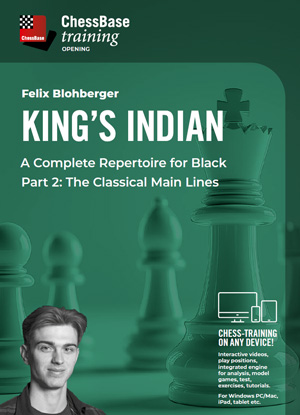
Complete Repertoire for Black Part 2: The Classical Main Lines
by Felix Blohberger
http://www.chessbase.com
E-Mail
info@chessbase.com
2026
Price Euro 49.90
Windows 7 or higher
Minimum: Dual Core, 2 GB RAM, DirectX11, graphics card with 256 MB RAM,
DVD-ROM drive, Windows Media Player 9, ChessBase 14/Fritz 16 or
included Reader and internet access for program activation.
Recommended: PC Intel i5 (Quadcore), 4 GB RAM, Windows 10, DirectX11,
graphics card with 512 MB RAM or more, 100% DirectX10-compatible sound
card, Windows Media Player 11, DVD-ROM drive and internet access for
program activation.
MacOSX only available as download! Minimum: MacOS "Yosemite"
10.10
The young chess genius Grandmaster Felix Blohberger provides the user
with a detailed move to move coverage of the good old King’s Indian
Defence.The author has managed to produce a compressive and workable
black repertoire against all of white most dangerous possibilities.
A small overview:
Introduction
Queen's Pawn Games: 1.d4 Nf6
Introduction
Early Gambits
1.d4 Nf6 2.Nf3 g6 3.Bf4 Bg7: London System
1.d4 Nf6 2.Nc3 d5 3.Bf4 g6: Jobava London
1.d4 Nf6 2.Bg5 g6: Trompovsky
1.d4 Nf6 2.Nf3 g6 3.Bg5 Bg7
1.d4 Nf6 2.Nf3 g6 3.Nbd2 Lg7
Exercises with point system (Books)
Exercises in ChessBase format
Fianchetto Systems (g3 & b3)
and part two:
1.d4 Nf6 2.c4 g6 3.Nc3 Bg7 4.e4 d6 - Introduction
Systems without 5.Nf3
Introduction
Four Pawns Attack: 5.f4 0-0
5.Bd3 0-0 6.Nge2 Nc6
5.Nge2 0-0 6.Ng3 h5
Exercises with point system (Books)
Exercises in ChessBase format
5.Be2
Introduction
Early h4: 5.Be2 0-0 6.h4 h5
5.Be2 0-0 6.Be3 Na6
Averbakh: 5.Be2 0-0 6.Bg5 Na6
Exercises with point system (Books)
Exercises in ChessBase format
5.f3 - Saemisch
Introduction
Sidelines & 5.f3 0-0 6.Bg5 a6
Main Lines: 5.f3 0-0 6.Nge2 a6 7.Be3 & 6.Be3 b6
Exercises with point system (Books)
Exercises in ChessBase format
5.h3
Introduction
Sidelines: 5.h3 0-0 6.Nf3/Nge2/Bd3
5.h3 0-0 6.Nf3 Na6 7.Bg5 c6 & 5.h3 0-0 6.Bg5 Na6
5.h3 0-0 6.Be3 Na6 Part 1
7.Nf3 c6 8.Be2 e5 9.d5 Nh5 Part 2
Exercises with point system (Books)
Exercises in ChessBase format
Systems with 5.Nf3 - Sidelines
Early Sidelines - Introduction
5.Nf3 0-0: Sidelines on move 6
6.Be2 Na6: Sidelines on move 7
Sidelines - Introduction
5.Nf3 0-0 6.Be2 Na6 7.Be3 e5
7.0-0 e5: Sidelines on move 8
8.d5 Nc5
Exercises with point system (Books)
Exercises in ChessBase format
Systems with 5.Nf3 - Main Lines
Introduction
5.Nf3 0-0 6.Be2 Na6 7.0-0 e5 8.Re1
8.Be3 Qe7 Sidelines
9.d5 Ng4
9.dxe5 dxe5
Exercises with point system (Books)
Exercises in ChessBase format
Practice Repertoire
Systems without 5.Nf3
5.Be2
Sämisch 5.f3
5.h3
Classical Setup Early Sidelines
Classical Setup Sidelines
Classical Setup Main Lines
Practice Positions
Four Pawns Attack 1
Four Pawns Attack 2
5.Bd3 6.Nge2 1
5.Bd3 6.Nge2 2
5.Bd3 6.Nge2 3
5.Nge2
Early h4
5.Be2 6.Be3 1
5.Be2 6.Be3 2
Introduction
1.c4 Nf6 2.Nc3 g6 3.g3 Bg7 4.Bg2 0-0 5.e4 d6 6.Nge2 c5: Botvinnik
Triangle
1.d4 Nf6 2.g3
g3-systems Part 1: Early deviations - 1.Nf3 Nf6 2.g3 g6 3.Bg2 Bg7 4.0-0
0-0 5.d4 d6
g3-systems Part 2: without d4 - 1.Nf3 Nf6 2.g3 g6 3.Bg2 Bg7 4.0-0 0-0
5.c4/d3
g3-systems Part 3: Main Lines - 1.d4 Nf6 2.c4 g6 3.Nf3 Bg7 4.g3 0-0
5.Bg2 d6 6.Nc3/0-0
Double Fianchetto: 1.Nf3 Nf6 2.g3 g6 3.b3 Bg7 4.Bb2 0-0 5.Bg2 d6
Early b3 Fianchetto: 1.Nf3 Nf6 2.b3 g6 3.Bb2 Bg7
Exercises with point system (Books)
Exercises in ChessBase format
Sidelines with 1.d4 Nf6 2.c4 g6
Introduction
1.d4 Nf6 2.c4 g6 3.d5 Bg7
Smyslov System: 1.d4 Nf6 2.c4 g6 3.Nc3 Bg7 4.Nf3/Bg5
Delayed London: 1.d4 Nf6 2.c4 g6 3.Nc3 Bg7 4.Bf4 & 4.Nf3 d6 5.Bf4
Reversed King's Indian Attack: 1.d4 Nf6 2.c4 g6 3.Nf3 Bg7 4.e3 0-0
5.Be2 d6 6.Nc3 Bf5
Exercises with point system (Books)
Exercises in ChessBase format
Bonus
Strategical ideas
Model Game 1
Model Game 2
Model Game 3
Model Games
Exercises with point system (Books)
Exercises in ChessBase format
Practice Repertoire
Queen's Pawn Games
Fianchetto Systems
Sidelines with 1.d4 and 2.c4
Practice Positions
Early Gambits
London System
Jobava London
Trompowsky
1.d4 2.Nf3 3.Bg5
1.d4 2.Nf3 3.Nbd2
Botvinnik Triangle
1.d4 2.g3
g3-systems 1
g3-systems 2
g3-systems 3
Double Fianchetto
Early b3 Fianchetto
1.d4 2.c4 3.d5
Smyslov System
Delayed London
Reversed King's Indian Attack
The King’s Indian has always been one of the sharpest most complex and
popular that Black can go for.
Conclusion: Very important reference
coverage of the King’s Indian!